Go live. Meet real. Be you.
I designed and built Zuvo Live, a live-streaming and 1-on-1 video calling app, from an idea to a live product, with real login, real-time call ringing and secure video rooms.
- 7working features
- 12/12end-to-end checks passed
- 3languages: English, Bangla, Hindi
- 2layouts from one codebase
Face-to-face, built for South Asia first
I wanted a social video app where people can go live, meet new friends and talk face to face, built for South Asian users first but usable anywhere. Most apps in this space are mobile-only, English-only, and feel the same.
Real conversations, not a mock-up
Actual video calls that ring the other person, not a demo screen.
One product, two experiences
A full website on laptops and an app-style experience on phones.
Local by default, global by choice
English first, with Bangla and Hindi one tap away.
Safe from day one
Only the right people can join a call, and nobody can tamper with coins.
Idea to live URL, end to end
I owned the whole product: idea, naming, brand, UI design, front-end, back-end, database, security, testing and deployment. I worked AI-assisted, directing every decision and reviewing each step in the browser. The first working version went from an empty folder to a live URL in a single day.
| Concept | Studied popular live-video apps, picked the core flows, named the product Zuvo Live |
|---|---|
| Design | Dark neon UI, original logo, mobile app screens and a desktop website |
| Build | Video rooms, login, profiles, call ringing, chat, Go Live, languages |
| Secure | Database rules, server-checked video tokens, secrets kept out of code |
| Ship | 12/12 end-to-end checks passed, live on Vercel |
Seven working features, not placeholders
| 1-on-1 video calls | Tap Video Call; the other person's screen rings with a ringtone; Accept joins both into a private video room. Live |
|---|---|
| Go Live | Start a camera stream; viewers watch, comment and send hearts in real time. Live |
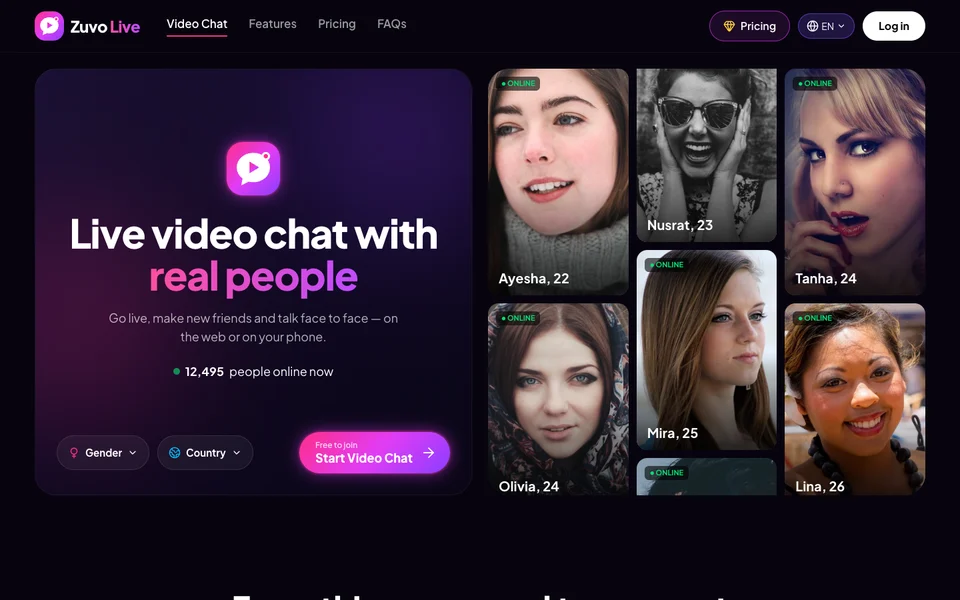
| Discover | Hot / Live / Party / Match tabs, real users with a green Online badge. Live |
| Chat | Private messages delivered instantly and saved to the database. Live |
| Accounts | Email sign-up and login, editable profile, host mode, 100 starter coins. Live |
| Languages | English by default; Bangla and Hindi via a picker after first login. Live |
| Coins & VIP | Coin packs (৳99–৳2,399) and a ৳299/month VIP plan on the pricing page. Designed; payments next |
Why it looks and works this way
An original brand
Zuvo Live is short and easy to say in any language, with the tagline “Go live · Meet real · Be you”. The logo is a chat bubble with a play button and a live dot, drawn as SVG so it stays sharp from favicon to splash screen.
Dark neon
A deep purple background with a pink-to-violet gradient and soft glows, so faces and video stand out. Generic “AI sparkle” icons were replaced with meaningful ones: music, mic, coffee, handshake.
Right layout for each screen
- On phones it is an app: bottom navigation, a floating Go Live button, full-screen calls
- On laptops it is a website: a hero with “Start Video Chat”, a live wall of online people, features, pricing and FAQs
A first-class feature
Every screen reads from one translation file. English is the default; after first login users pick their language, and can switch any time from the globe button or their profile.
One call in five steps
A call is a row in the database that both phones watch: the caller creates it, the other person's screen rings, and only after Accept does the server hand each of them a key to the same private video room.
- Caller taps Video CallA call record is created with the status “ringing”.
- The other phone ringsSupabase Realtime pushes the record to the callee, who sees the incoming call with a ringtone.
- Accept or declineThe status moves to accepted, declined, or missed after 30 seconds with no answer.
- Server hands out keysOnly a logged-in caller or callee of an accepted call gets a LiveKit video token.
- Both join one private roomLiveKit's WebRTC server connects the two cameras; nobody else can join.
What it runs on
| Front-end | Next.js 16, React 19, TypeScript, Tailwind CSS 4. One codebase for the website and the app screens. |
|---|---|
| Video | LiveKit Cloud (WebRTC SFU). Scales from 1-on-1 calls to one-to-many live streams. |
| Auth & database | Supabase (Postgres + row-level security). Login, data and security rules in one place. |
| Real-time | Supabase Realtime + Presence. Instant call ringing, accept/decline, chat, online status. |
| Hosting | Vercel. HTTPS (needed for cameras on phones) and auto-deploy on every push. |
| Code | Git version control, with no secrets in the code. |
Problems and fixes
A call has to ring the other phone, not just share a room link
Built call signaling: a call record moves ringing → accepted / declined / missed, pushed live to both sides. 30 seconds with no answer ends as “No answer”.
Anyone with a room name could join a video call
The server issues a video token only to a logged-in user who is the caller or callee of an accepted call.
Users could edit their own coin balance from the browser
Database rules block any self-edit of coins; only server-side logic will change them.
The page crashed when the browser blocked the camera
The call now keeps running and shows clear steps to allow camera and mic.
Cameras don't work on phones without HTTPS
Deployed on Vercel so the live site runs on HTTPS.
Hosting storage was almost full (9.6 of 10 GB)
Cleaned up 514 old deployments of another project, keeping its live site online the whole time.
Keys must never leak into the code
Keys live only in local env files and Vercel settings, and the code was checked before and after every push.
Zuvo Live is live and tested. 12 of 12 end-to-end checks passed with two test accounts: login, auto-created profiles, coin protection, live ringing, accept, video tokens, blocked strangers and chat.
What comes next
- Coin payments FirstbKash / SSLCommerz and per-minute billing during calls.
- Push notificationsSo calls ring even when the app is closed.
- Party Rooms and MatchReal group rooms and random matching.
- Report and blockSafety tools for every user.
- Android appOn Google Play, wrapping the same web app.